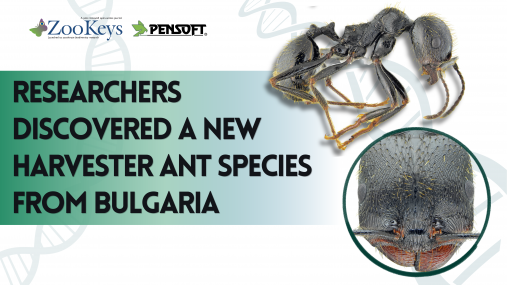
An international team of researchers has announced the discovery of a new species of harvester ant, officially named Messor odrysarum. The discovery was made by researchers Albena Lapeva-Gjonova of Sofia University in Bulgaria and Lech Borowiec of the University of Wrocław in Poland.
The findings were recently published in the scientific journal ZooKeys and bring the total number of recognized Messor ant species in Bulgaria to nine.
The newly discovered ant species, Messor odrysarum, is a seed-collecting ant named in honor of the ancient Thracian kingdom of Odrysia, which once ruled the region of its discovery.
This lowland species nests at ground level along dirt roads in the forests and grasslands of Bulgaria's Eastern Rhodopes, where piles of seed remains can be seen outside its nest entrances in late summer. Currently only confirmed in Bulgaria, researchers suspect its range also extends into neighboring Greece and Turkey.
Distinct Physical Characteristics
The newly discovered species belongs to the Messor structor species group and it's closely related to the known Balkan-Anatolian species Messor oertzeni. However M. odrysarum stands out with a smaller overall body size compared to its close relatives and it is accented only by reddish hues on the lower genae (the cheek region of the head). It also has a narrowed head behind the eyes, longer and denser hairs (setae) on its head and midsection, and a longer antennal scape.
DNA barcoding
Authors of the study complement the detailed morphological description by COI data and biological and diagnostic data for one of them, confirming its status as a new species. A COI sequence of the new species has been previously published by Lapeva-Gjonova et al. (2025) (BOLD accession BGANT009-23, BIN: BOLD:AES9246).
Scientific Significance
The formal description of Messor odrysarum helps to resolve ongoing taxonomic complexities within the Messor genus, which is known for cryptic diversity and remarkable reproductive strategies like hybridization or even xenoparity, where female gives birth to, or clones, offspring of a completely different species as part of its lifecycle.
In addition to introducing the new species, the researchers' publication also provides a rare, updated redescription of the queen (gyne) caste of the related M. oertzeni based on newly collected specimens.
Original source:
Lapeva-Gjonova A, Borowiec L (2026) A new species of Messor from Bulgaria and redescription of the gyne of M. oertzeni Forel, 1910 (Hymenoptera, Formicidae). ZooKeys 1275: 145-168. https://doi.org/10.3897/zookeys.1275.181745
Other sources used:
Lapeva-Gjonova A, Pramatarova M, Borowiec L, Gjonov I, Kostova R, Bekchiev R, Borissov S (2025) DNA barcoding of Messor ants of Bulgaria with insights into their taxonomic diversity. Biodiversity Data Journal 13: e168586. https://doi.org/10.3897/BDJ.13.e168586